Exhaust Drone and Fitment Problems on Modified Cars
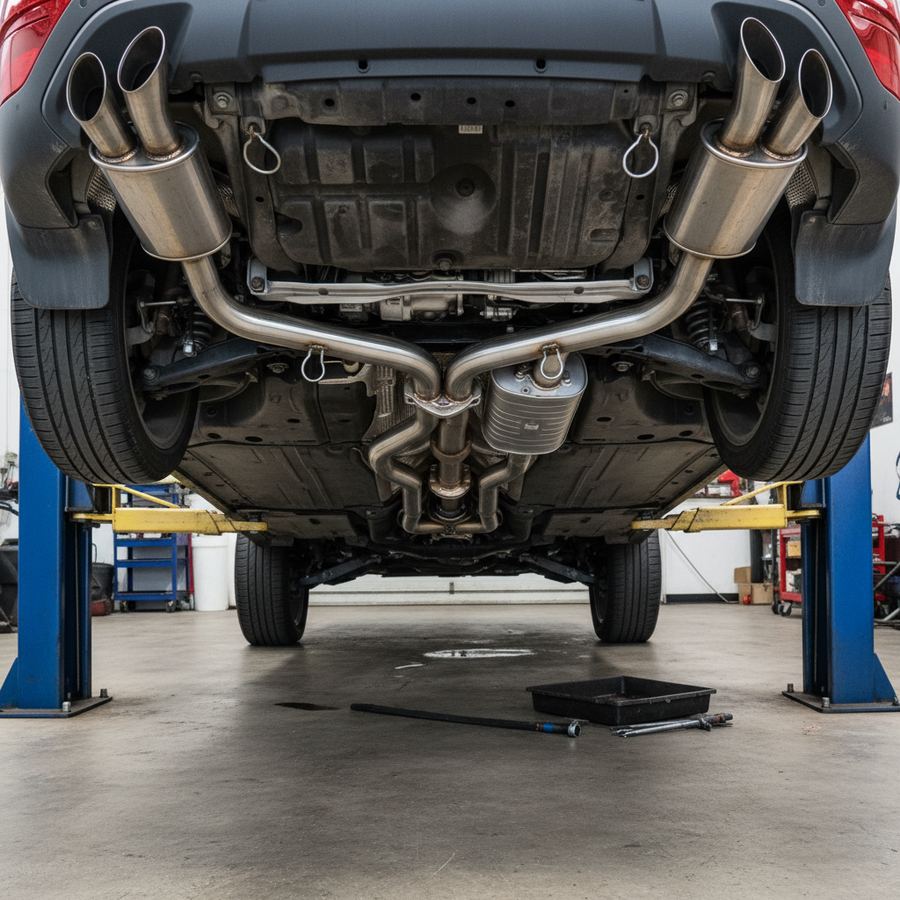
You researched the brand, watched the sound clips, and finally pulled the trigger on an aftermarket exhaust. Two weeks later, you are ready to rip it off the car. The drone on the highway is unbearable, and something is buzzing against the underbody every time you go over a bump. This is one of the most common complaints in the modified car world, and it is almost always preventable.
What Exhaust Drone Actually Is
Drone is a low-frequency resonance that occurs when the exhaust note hits a frequency that the cabin amplifies. It is not the same as being loud. A loud exhaust at wide-open throttle can sound incredible. Drone happens at steady-state cruising, usually between 2,000 and 3,000 RPM, and it is a deep, pulsing hum that makes your head feel like it is in a pressure chamber.
Sound waves exit the tailpipe at specific frequencies determined by engine RPM, firing order, and pipe length. When one of those frequencies matches a resonant frequency of the cabin, the interior acts like a speaker box. The sound gets amplified instead of dissipated. This is why drone shows up at a specific RPM range and disappears above or below it. Turning up the radio does not fix it. You feel it in your chest and sinuses as much as you hear it.
Which Systems Are Most Prone to Drone
Muffler deletes are the worst offenders. Removing the muffler entirely eliminates the one component specifically designed to break up sound wave patterns and reduce resonance. On some V8 cars with long exhaust paths, a muffler delete might sound acceptable because the pipe length and system layout naturally dampen certain frequencies. On four-cylinder and V6 cars, a muffler delete almost always produces terrible drone.
Resonator deletes are a close second. The resonator is a tuned chamber that cancels specific frequencies. It does not reduce volume as much as a muffler does. Its job is to target the exact frequencies that cause drone. Removing it because you want more sound is like removing a bandage because you want to see the wound. You will see it, and you will not like it.
Straight-through muffler designs (glasspack style) are better than a delete but still drone-prone. They reduce volume through absorption using fiberglass packed around a perforated core tube. Over time, the packing breaks down from heat and vibration, and the exhaust gets louder and dronnier as the car ages.
Chambered mufflers (like many Flowmaster designs) use internal baffles to redirect sound waves so they cancel each other out. They are generally better at preventing drone, but the wrong chamber design on the wrong car can still produce resonance. There is no universal solution. It depends on engine type, RPM range, pipe diameter, and cabin characteristics.
How to Fix Drone Without Starting Over
If you already have a system installed and drone is ruining your highway drives, you have options short of replacing the entire exhaust.
Add a resonator. If your system has none, welding one into the mid-pipe is the most effective fix. A Vibrant or Magnaflow universal resonator can be installed by any exhaust shop for $100 to $200 including labor. Placement matters. Ideally, it goes roughly one-third of the way between the catalytic converter and the muffler.
Try a different muffler. If your muffler is a straight-through design and you are getting drone, swapping to a chambered design often solves it. Drone is frequency-specific, and changing the muffler changes which frequencies get cancelled.
Helmholtz resonator. A small side-branch chamber welded onto the exhaust pipe. Tuned to the right frequency, it cancels the specific drone frequency without changing the overall note much. Some manufacturers sell bolt-on versions. A good fabricator can build one tuned to your problem frequency.
Electronic exhaust valves. A valve system that opens and closes a bypass lets you choose when the full exhaust opens up. It is the most expensive option at $300 to $800, but it completely solves the drone-vs-sound tradeoff.
Fitment: The Other Half of the Problem
Drone gets all the forum complaints, but fitment issues cause just as much frustration. An aftermarket exhaust that does not fit properly will rattle, vibrate, leak, and potentially cause heat damage to surrounding components.
Hangers and Mounting Points
Exhaust hangers are rubber isolators that suspend the system from the underbody. They absorb vibration and allow slight movement as the car flexes over bumps. Aftermarket systems sometimes move hanger locations or use fewer hangers than stock. When the weight distribution changes, the exhaust can sag, shift to one side, or put stress on connection points. The result is contact with the underbody, heat shielding, suspension components, or the driveshaft on rear-wheel-drive cars.
After any install, get the car on a lift and check clearance everywhere. Push on the exhaust in different directions to simulate movement over bumps. There should be at least half an inch of clearance to everything surrounding the pipes. If anything is close, it will make contact eventually.
Polyurethane exhaust hangers are marketed as an upgrade, but they are stiffer than rubber, which means they transmit more vibration into the cabin. On a daily driver, they make every NVH issue worse. Stick with rubber hangers for street use.
Flange and Clamp Connections
Exhaust systems connect at flanges (bolted gasket joints) and slip joints (pipe-over-pipe with clamps). Flanges are more secure. Clamp joints are easier to install but more prone to leaks if the clamp is loose or the pipe diameters do not match.
Leaks at connection points are the most common fitment issue. A small leak sounds like a ticking at idle that goes away at higher RPM. A larger leak produces a raspier sound and can trip oxygen sensor codes because unmetered air enters the exhaust stream. If you are having tuning issues after an exhaust swap, check for leaks first. They mess with wideband readings and confuse the data your ECU logs.
Heat Shield and Clearance Issues
Stock exhaust systems include heat shields over sections that pass near fuel lines, brake lines, wiring harnesses, and floor pans. When you change the exhaust routing or increase pipe diameter, those shields may no longer cover the right areas. On a lowered car, clearance between the exhaust and the floor pan shrinks further. Add a higher-flow downpipe that runs hotter than stock, and you can get heat soak into the cabin or heat damage to wiring and brake lines.
Exhaust wrap is a common fix for heat issues. It works, but it traps moisture against the pipe and accelerates corrosion on mild steel systems. A better long-term solution is proper heat shielding with an air gap, or ceramic coating the sections of pipe that run near sensitive components.
The Install Matters More Than the Brand
A mid-tier exhaust system installed correctly will outperform a top-shelf system installed poorly. Proper alignment, correct hanger tension, leak-free connections, and adequate clearance are what separate an exhaust that works for years from one that becomes a constant annoyance.
Take the time to do the install right the first time. Get it on a lift. Check every connection for leaks with the engine running. Verify clearance with the suspension at full compression. Push and pull on the system to simulate road movement. These steps take an extra 30 minutes and save you from pulling everything apart two weeks later.
If you are paying a shop to do the work, ask them to verify clearance and check for leaks before you pick up the car. A good shop does this automatically. A bad shop bolts it on and hands you the keys. The difference between the two is usually obvious by the time you hit the highway on the way home.