Coilovers vs Lowering Springs for Street Cars
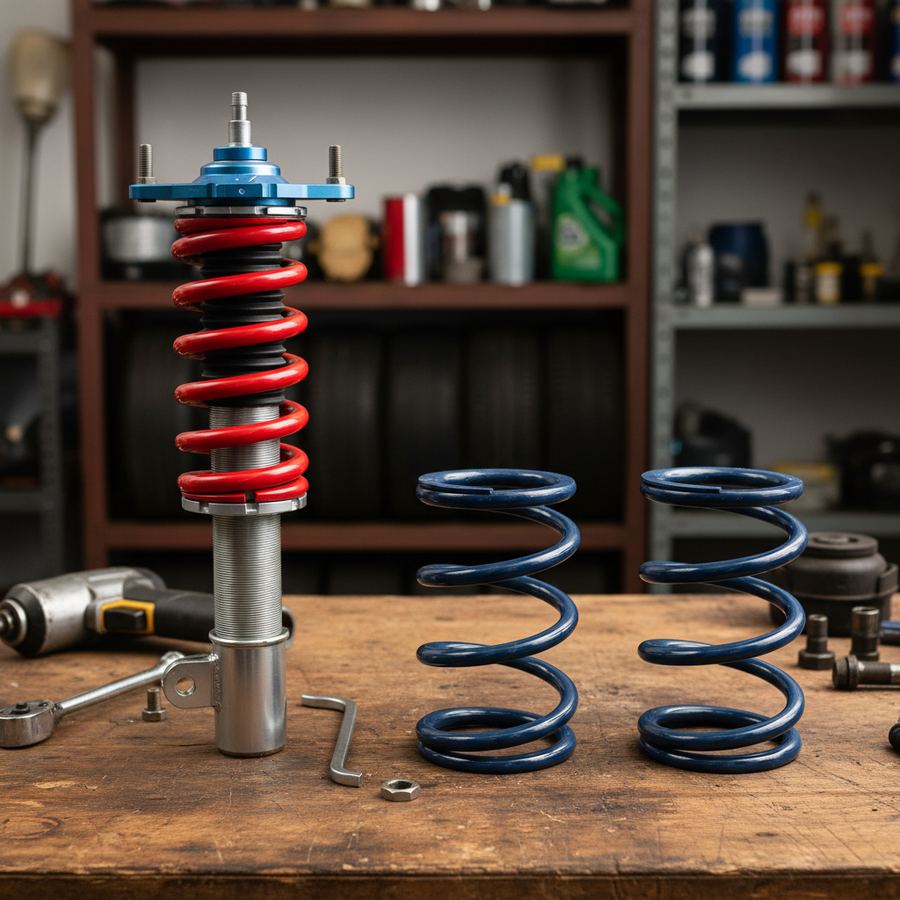
You want to lower your car. You have two main options: lowering springs that replace the factory springs and work with your stock struts, or a full coilover kit that replaces the entire strut and spring assembly. Both will lower the car. Both will change how it handles. But they are fundamentally different products aimed at different budgets and different goals, and the wrong choice will cost you more than the right one.
Lowering Springs: Simple, Cheap, Compromised
Lowering springs are exactly what they sound like. Shorter, stiffer springs that bolt onto your existing struts. They drop the car 25 to 40 mm depending on the kit, stiffen the ride, and change the look. Installation is straightforward. Remove the old spring, install the new one. A competent shop can do it in two to three hours.
The appeal is price. A quality set of lowering springs from brands like Eibach, H&R, or Whiteline costs $250 to $450. That is the cheapest way to lower a car and get a noticeable handling improvement. Compared to coilovers, which start at $800 and go well past $2,000, springs are attractive for budget builds.
The compromise is that springs are working with struts that were not designed for them. Factory struts are valved for the factory spring rate and ride height. When you shorten the spring and increase the rate, the strut cannot control the spring as well. The result is a ride that bounces more than it should, especially over uneven surfaces. The strut's compression and rebound damping does not match the new spring, so the car feels unsettled over bumps and sometimes crashes into potholes because the strut bottoms out at the reduced ride height.
Spring manufacturers design their products to work reasonably well with stock struts, but "reasonably well" is a compromise. The ride will be stiffer than stock and less controlled than a proper coilover that was designed as a matched unit. On smooth roads, lowering springs feel great. On rough roads, the mismatch between spring and strut becomes obvious.
There is also the strut wear issue. Stock struts have a finite life, typically 80,000 to 120,000 km. Running stiffer springs through a strut that is already halfway through its life will accelerate wear. If your car has 60,000 km on the original struts, installing lowering springs means the struts might need replacement within 20,000 to 30,000 km. At that point, you are buying new struts anyway, and the total cost starts approaching coilover territory.
Coilovers: Adjustable, Better, Expensive
A coilover replaces the entire strut assembly with a unit that was engineered as a system. The spring rate, damper valving, and ride height adjustment are all designed to work together. This is the fundamental advantage of coilovers over springs. Nothing is compromised by pairing mismatched components.
The practical benefits are significant. Ride height is adjustable, so you can set the exact drop you want rather than accepting whatever a spring manufacturer decided. On most coilovers, you can adjust the height independently at each corner, which lets you level the car and even perform a basic corner balance. Damping adjustment, available on mid-range and higher coilovers, lets you tune the ride from soft to firm depending on the road or your mood.
Good coilovers ride better than lowering springs on the same car. This sounds counterintuitive because coilovers are often stiffer, but the key is that the damper is matched to the spring. A properly valved coilover controls the spring throughout its travel, absorbing bumps cleanly instead of bouncing off them. The car feels planted and composed rather than bouncy and unsettled. Over rough roads, the difference between a quality coilover and lowering springs on tired struts is night and day.
Price is the barrier. A quality street coilover from brands like KW, Bilstein, BC Racing, or Fortune Auto costs $1,000 to $2,500 depending on the platform and feature level. Budget coilovers exist for $500 to $800, and this is where the conversation gets complicated.
Why Cheap Coilovers Are Worse Than Good Springs
This is the point that forums and YouTube often get wrong. A $500 coilover kit from an unknown brand is not automatically better than a $400 set of Eibach springs on good struts. In many cases, it is worse.
Cheap coilovers cut costs on the damper. The valving is crude, often using a simple compression valve that creates a harsh, underdamped ride. The internal components are low-quality steel that wears quickly. The seals leak after 20,000 to 40,000 km. The ride quality starts out mediocre and degrades as the damper wears, eventually feeling like the car has no damping at all. A blown cheap coilover bounces like a pogo stick and is genuinely dangerous because the tire loses contact with the road over bumps.
The spring rates on cheap coilovers are often arbitrary. Instead of engineering the rate for the specific vehicle's weight distribution and intended use, budget manufacturers use generic rates across multiple platforms. The result is a car that is too stiff on one end and too soft on the other, creating handling imbalances that are worse than stock.
Thread quality on the ride height adjustment is another weak point. Cheap coilovers use mild steel threads that corrode quickly. Within a year or two, the locking rings seize and you lose the ability to adjust ride height, the one feature that justified choosing coilovers in the first place.
If your budget is $500 for suspension, you are better off buying quality lowering springs from a reputable brand, pairing them with your factory struts (assuming they are not worn out), and spending the leftover money on a proper alignment. That combination will ride better, last longer, and handle more predictably than a bottom-shelf coilover.
What Actually Improves Handling vs What Just Looks Lowered
Lowering a car does not automatically improve handling. It changes the centre of gravity, which helps. But it also changes the suspension geometry in ways that can hurt handling if not addressed. Camber increases, roll centre drops, and the suspension travel decreases. On a car lowered 40 mm with no other changes, you have less grip available over bumps because the reduced travel means the tire unloads sooner.
The handling improvement from lowering comes from the combination of a lower centre of gravity, increased spring rate, and corrected alignment. If you lower the car but skip the alignment, you have a car that looks lower but handles worse because the tires are wearing unevenly and the geometry is wrong. If you lower it 60 mm on stiff springs but do not upgrade your sway bars, end links, or control arms, you have a car that rides harshly but still rolls too much in corners because the anti-roll system has not been addressed.
A car that handles well is a system where every component works together. Dropping the ride height is one piece of that system, not the whole thing. If your goal is better handling and not just the lowered look, plan your suspension modifications as a package rather than bolting on parts one at a time.
The Ride Quality Question
For a daily-driven car, ride quality is not a luxury concern. It is a fatigue and safety issue. A car that crashes over every expansion joint and potholes on your commute is unpleasant to drive, and unpleasant cars eventually get parked. The goal should be a car that handles well and rides well enough to drive every day without hating it.
Lowering springs on good struts with a 25 to 30 mm drop will stiffen the ride noticeably but keep it livable for most people. The car feels tighter and more responsive without being punishing. This is a good setup for someone who wants a modest improvement without overhauling the whole suspension.
A quality coilover with adjustable damping gives you the ability to find the balance that works for your roads and your tolerance. Set the dampers soft for the commute and firm them up for a weekend drive. This flexibility is the biggest practical advantage of coilovers for street use. You are not locked into one ride quality for the life of the product.
A cheap, non-adjustable coilover gives you the worst of both worlds. It rides harshly because the damping is unrefined, and you cannot soften it because there is no adjustment. Over rough roads, it is significantly worse than stock suspension. If ride quality matters to you, and on a daily driver it should, either buy a coilover with damping adjustment or stick with springs.
The Decision Framework
Buy lowering springs if: Your budget is under $500, your stock struts have less than 60,000 km on them, you want a mild 25 to 35 mm drop, and you are okay with a stiffer but non-adjustable ride. Pair them with a proper alignment and you have a solid street setup that will serve you well for years. Factor in the cost of replacing struts down the road.
Buy coilovers if: Your budget is $1,000 or more, your stock struts are worn or you want to replace everything at once, you want adjustable ride height and damping, or you plan to upgrade other suspension components as part of a larger handling package. Get a brand with a good reputation for street ride quality, not just track performance.
Do not buy cheap coilovers if: You are choosing them only because they are cheaper than a quality set. A $500 coilover that rides poorly and leaks within two years is not a bargain. It is money wasted that could have gone toward a product that actually works.
Whatever you choose, the alignment after installation is not optional. It is part of the job. Lowering the car without aligning it is like building an engine without tuning it. The parts might all be there, but nothing is working together the way it should.