Why Alignment Is Mandatory After Lowering Your Car
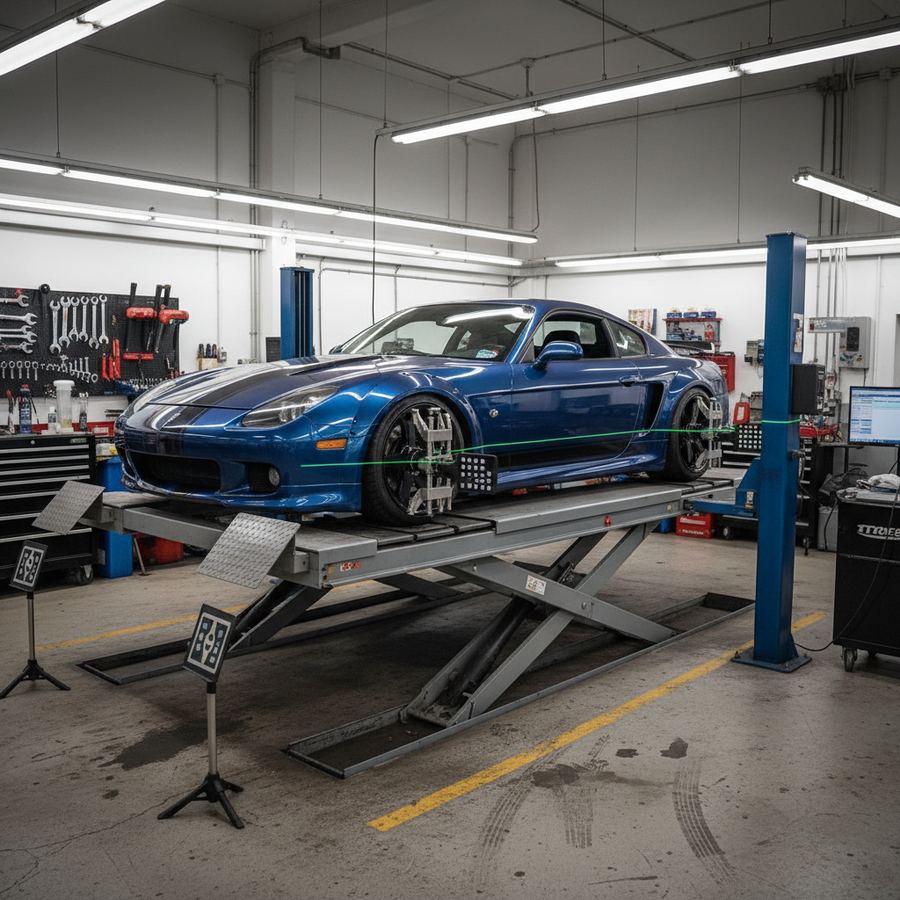
If you just installed lowering springs, coilovers, or any suspension modification that changes ride height, your alignment is wrong. Not slightly off. Significantly wrong. Every millimetre of ride height change alters the camber, toe, and caster angles that determine how your tires contact the road. Driving on a lowered car without realigning it is actively destroying your tires and making your car handle worse than stock.
This is not a suggestion or a "nice to have." It is a mandatory step that should happen within a week of any suspension change. Skipping it does not save money. It just shifts the cost from a $150 alignment to a $1,000 set of tires that wear out in half the time.
What Changes When You Lower the Car
Suspension geometry is designed around the factory ride height. The lengths and angles of your control arms, tie rods, and struts all assume the car sits at a specific height. When you change that height, every angle changes with it.
Camber
Camber is the inward or outward tilt of the wheel when viewed from the front. On most cars, lowering increases negative camber, meaning the top of the wheel tilts inward. The amount depends on the suspension design and how much you have lowered the car. Whether you went with coilovers or lowering springs, the effect on camber is similar for the same drop amount.
MacPherson strut cars are the most sensitive. A 30 mm drop typically adds 0.7 to 1.2 degrees of negative camber. A 50 mm drop can add 1.5 to 2.0 degrees. Since most cars come from the factory with camber set around -0.5 to -1.0 degrees, a 50 mm drop can push front camber to -2.0 to -3.0 degrees. That is enough to wear the inner edge of a performance tire bald within 10,000 km.
Double-wishbone and multilink suspensions handle lowering better because the geometry naturally limits camber gain. But even on these platforms, a significant drop will push camber beyond acceptable street limits without adjustment.
Toe
Toe is whether the wheels point inward or outward relative to each other. Lowering the car changes the angle of the tie rods and trailing arms, which pulls or pushes the wheels into toe-in or toe-out depending on the design.
Toe changes from lowering are usually smaller than camber changes, but toe is far more sensitive to tire wear. A 2 mm shift in total toe creates a scrubbing action that wears tires measurably within 5,000 km. Because the toe change from lowering varies by platform and is not always predictable from the drop amount alone, the only way to know where you stand is to measure it on an alignment rack.
On the rear axle, toe changes from lowering are especially common on multilink suspensions. The trailing arms and lateral links change angle as the knuckle moves upward, which can introduce rear toe-out. Rear toe-out causes oversteer instability and aggressive inner edge wear on both rear tires. This is the most common reason lowered cars eat rear tires faster than fronts.
Caster
Caster is the forward or rearward tilt of the steering axis. Lowering typically increases caster slightly because the lower control arm angle steepens. More caster improves straight-line stability and steering feel, so this change is usually welcome. However, increased caster also means more camber change during steering input, which affects how the front tires wear during cornering.
Caster is rarely a problem by itself after lowering, but it interacts with camber and toe in ways that affect the overall handling balance. A good alignment tech will check caster as part of the full picture and ensure it is equal side to side, which prevents the car from pulling.
How to Spec an Alignment for a Lowered Street Car
Factory alignment specifications do not apply to lowered cars. They were written for stock ride height, stock components, and stock tire sizes. A lowered car needs its own targets, and those targets depend on how you use the car.
For a daily-driven lowered street car, here are practical targets that balance grip with tire longevity:
Front camber: -1.0 to -1.5 degrees. This range gives you improved cornering grip without destroying the inner edges during straight-line driving. If your car is dropped far enough that the camber reads -2.0 or worse and you cannot adjust it to this range, you need camber correction hardware. Camber bolts cost $30 to $80 and give you roughly 1 degree of adjustment. Adjustable upper strut mounts cost $150 to $400 and give you more range with finer adjustment.
Rear camber: -1.0 to -1.8 degrees. The rear can tolerate more negative camber than the front because the rear tires do not steer, which means no additional scrubbing from turning. On cars with adjustable rear camber arms (one of the suspension parts that actually make a difference), set them to the lower end of this range for maximum tire life, or the higher end if you want better cornering balance.
Front toe: 0 to 1 mm total toe-in. A small amount of toe-in stabilizes the steering and protects the outer edges. Zero toe is acceptable if the car feels stable at highway speed. Toe-out on the front can improve turn-in response but wears the inner edges and makes the car feel nervous on the highway. For a daily driver, avoid front toe-out.
Rear toe: 1 to 2 mm total toe-in. Rear toe-in is essential for stability and tire life on a lowered car. It keeps the rear end planted during deceleration and cornering. Never run rear toe-out on a street car. It creates oversteer tendency and chews through rear tires.
Caster: Equal side to side, as close to factory spec as possible. Unequal caster causes the car to pull toward the side with less caster. On most platforms, lowering does not change caster enough to require adjustment, but it should be checked and corrected if it is more than 0.3 degrees different side to side.
Corner Balancing: Worth It or Not
Corner balancing is the process of adjusting ride height at each corner so that the car's weight is distributed as evenly as possible across all four tires. On a race car, it is essential. On a street car, it is a nice-to-have that most people do not need.
If you have coilovers with independent ride height adjustment at each corner, a corner balance ensures the car is sitting level and that no single tire is carrying disproportionate weight. This improves handling consistency and reduces the tendency for one tire to wear faster than the others. It also makes the car look right. A car that sits 5 mm lower on one side because the coilover preload is different corner to corner looks and feels wrong.
For a street car with lowering springs, corner balancing is not practical because you cannot adjust the height at each corner independently. The springs set the height, and you get what you get. What you can do is ensure the car sits level by checking the ride height at each corner and confirming the springs are installed correctly. A car that leans to one side after a spring install usually has a spring seated incorrectly or a worn strut mount on one side.
If you have coilovers and access to corner scales, a basic corner balance is worth doing once. It takes about an hour with the right equipment and ensures your suspension is starting from an even baseline. After that, you set the alignment on a balanced platform, and both systems work together.
Finding the Right Alignment Shop
Not every shop that does alignments is equipped to handle a lowered car. Many chain shops set the alignment to factory specs and send you on your way. That is fine for a stock car. On a lowered car, factory specs may be unreachable because the geometry has shifted beyond the stock adjustment range. A technician who does not understand this will either set partial specs (aligning what they can and leaving the rest out of range) or tell you the car cannot be aligned and that you need to return it to stock height.
Look for a shop that works on modified cars regularly. Independent performance shops, race prep shops, and specialty alignment shops are more likely to have experience with lowered vehicles. They will know when camber correction parts are needed, how to set specs that balance performance with tire life, and how to work within the adjustment range of aftermarket components.
When you bring the car in, tell the technician what you want. Specify that the car is lowered, that you want the alignment optimized for street driving with an emphasis on tire life, and that you want a printout of the before and after specs. The printout is your reference for future alignments and lets you verify that the work was done correctly. Keep it in the glovebox.
When to Realign
Your alignment is not a one-time job. It needs to be rechecked and potentially adjusted under several circumstances.
After initial installation of any suspension modification: springs, coilovers, control arms, tie rod ends, sway bar end links, or strut mounts. Any component that connects the wheel assembly to the body affects alignment angles.
After adjusting coilover ride height. Even a 5 mm change in height alters the geometry. If you lower or raise the car seasonally or for events, the alignment should be checked after each change.
After hitting a major pothole or curb. A hard impact can bend a tie rod, shift a subframe, or knock a camber bolt out of position. If the steering wheel is suddenly off-centre or the car pulls to one side after an impact, get it checked immediately. Driving on a bent component accelerates tire wear and can be unsafe.
Every 15,000 to 20,000 km as part of routine maintenance. Even without an impact event, components settle, bushings wear, and minor shifts accumulate. A periodic check catches drift before it becomes visible on your tire wear patterns.
The Bottom Line
Lowering your car without aligning it is throwing money away. The tires will wear unevenly, the handling will be worse than stock, and you will spend more replacing tires early than you would have spent on the alignment. The wrong alignment settings on a good set of performance tires can halve their lifespan. The alignment is not a separate expense from the suspension modification. It is part of the same job. Budget for it when you buy the parts, and schedule it before you drive the car any more than necessary.
Book an alignment service within a week of installing any suspension mods. Bring the car in with the ride height set where you want it, and do not adjust the height again without rechecking the alignment. Your tires, your handling, and your wallet will all be better for it.