Supporting Mods That Matter: The Boring Parts That Keep Your Engine Alive
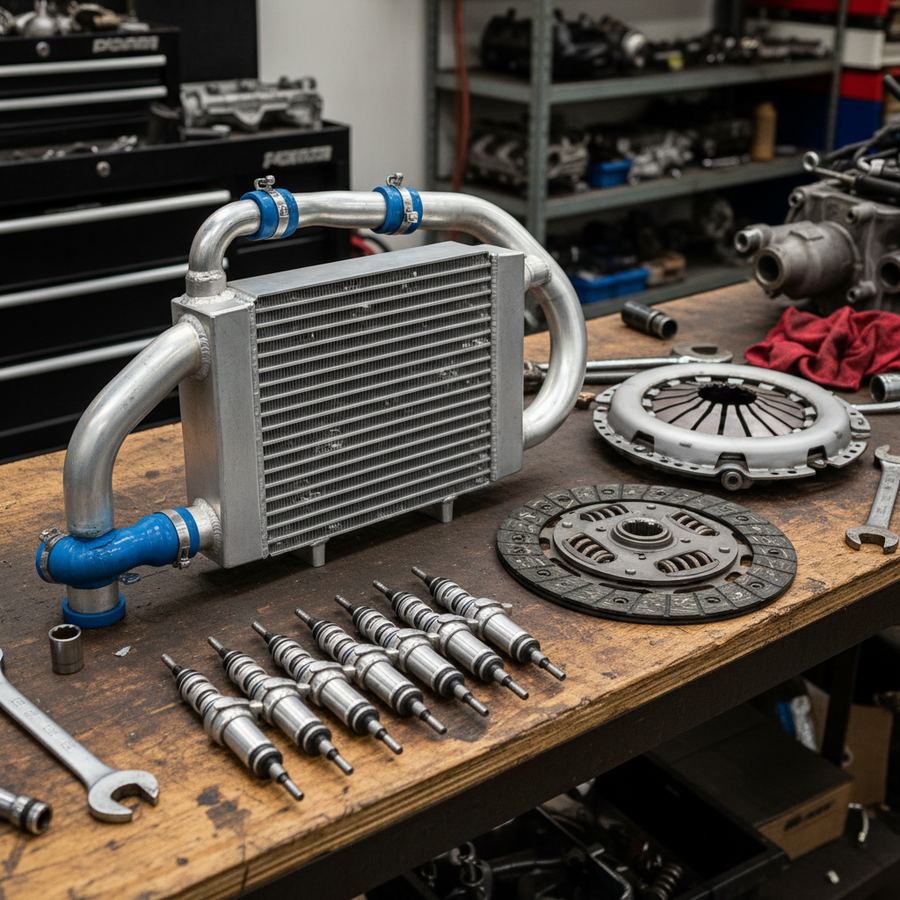
Nobody gets excited about a fuel pump. Nobody posts their new clutch on Instagram. But these are the parts that determine whether your 400 HP build lasts 100,000 miles or grenades on the highway. The performance parts industry sells the sizzle (turbo kits, intakes, exhausts) and glosses over the infrastructure that makes the power sustainable. This is about the mods that nobody wants to buy but everybody needs.
Fuel System: The Non-Negotiable Upgrade
Your fuel system is a flow problem. The engine needs a certain volume of fuel per minute at a certain pressure to hit the air-fuel ratio targets in the tune. Stock fuel systems are designed for stock power with some headroom, but that headroom disappears fast when you add boost.
Fuel pump. The stock high-pressure fuel pump (on direct injection cars) or the in-tank pump (on port injection setups) has a maximum flow rate. When your injector duty cycle starts hitting 85-90% at full load, you are at the edge. The pump cannot deliver enough fuel, the injectors cannot stay open long enough, and the tune goes lean. Not a little lean. Lean enough to cause detonation and melt things.
On most modern turbo platforms, the fuel pump upgrade is the first supporting mod you need. For GM direct injection cars, that is often an upgraded LPFP (low pressure fuel pump) that feeds the high-pressure pump. For Ford EcoBoost, it is often a larger HPFP (high pressure fuel pump) internals kit. For Subaru, it is typically an in-tank pump upgrade. The specific part varies, but the principle is universal: you cannot make power you cannot fuel.
Injectors. Stock injectors flow a specific amount of fuel per millisecond at a given pressure. If your tune needs more fuel than the injectors can physically deliver at 100% duty cycle, no amount of tuning software can fix it. Upgraded injectors with higher flow ratings give the tuner room to fuel the engine properly. On port injection systems, going from stock 440cc injectors to 550cc or 650cc injectors is often the difference between a tune that works and a tune that runs out of fuel at redline.
Fuel lines and regulators. On cars making serious power (500+ WHP on most platforms), stock fuel lines can become a restriction. The line diameter, the number of bends, and the condition of the fuel filter all affect delivered pressure. A fuel system that benchmarks fine at idle can drop pressure at high flow rates because the lines cannot keep up.
Intercooler: Managing Heat Is Managing Knock
Every degree of intake air temperature reduction is worth roughly 1-2 degrees of knock margin in ignition timing. On a hot day with a stock intercooler and a front-mount setup, intake air temps on a modified turbo car can hit 140-160F after a highway pull. After back-to-back pulls, it gets worse. Heat soak is when the intercooler core is so saturated with heat that it stops cooling effectively. The intake temps climb, knock increases, the ECU pulls timing, and your 350 WHP car makes 280 WHP.
A larger intercooler core with better fin density and more surface area keeps intake temps 20-40F lower under sustained load. That translates directly to more consistent power and more knock margin. On front-mount intercoolers, the upgrade is a larger core that replaces the stock unit. On top-mount setups (Subaru, some Mitsubishi), it is either a larger top-mount or a front-mount conversion.
This is not a power modification. It is a reliability modification that happens to make more consistent power as a side effect. If you are making more than about 30% over stock power on a turbo car and you still have the stock intercooler, you are running on borrowed time every time the ambient temperature climbs above 80F.
Cooling System: Oil and Coolant
More power means more heat. That is thermodynamics, and you cannot argue with it. The stock cooling system is designed for stock heat loads with some margin for towing or climbing a mountain pass. It was not designed for 400 HP sustained pulls.
Oil cooler. Oil temperature is critical. Above 260-270F, conventional oil starts breaking down and loses its ability to protect bearings and other surfaces. Synthetic oil buys you some margin, but physics is physics. If your oil temp is routinely above 250F during spirited driving, you need an oil cooler. Turbo cars are especially vulnerable because the turbo bearing housing is a major heat source.
Coolant capacity. A larger radiator, a more efficient fan setup, or a dedicated coolant overflow tank can help manage coolant temps. On track-driven cars, this is essential. On street cars, it depends on the power level and how hard you drive, but cooling upgrades are cheap insurance compared to an overheating event.
Transmission cooler. Automatic transmissions generate enormous heat under load, especially with increased torque. A dedicated transmission cooler keeps fluid temps in the safe range. If your modified car has an automatic and you are doing highway pulls or any kind of spirited driving, check your trans temp. Stock coolers are often marginal even at stock power levels.
Clutch and Drivetrain: Handling the Torque
A stock clutch on most modern turbo cars is rated for roughly stock torque plus 10-20% margin. Once you exceed that, the clutch starts slipping under hard load. At first it is subtle, maybe just a slight flare at the top of third gear. Then it gets worse. A slipping clutch generates enormous heat, which glazes the friction surfaces, which makes it slip more, which generates more heat. Within a few hundred miles of slipping, the clutch is destroyed and so is the flywheel surface.
Upgrading the clutch before you need it is always cheaper than upgrading it after it fails, because a failed clutch often takes the flywheel, release bearing, and sometimes the rear main seal with it. A quality single-disc clutch rated for your power level is the baseline. If you are making serious power (450+ ft-lbs), a twin-disc or multi-puck setup may be necessary.
Driveshaft. On rear-wheel-drive and all-wheel-drive cars, the driveshaft has a torque rating. Stock aluminum driveshafts on many platforms (370Z, G37, Mustang, Camaro) are rated for stock torque. Exceed that rating and the driveshaft can twist, develop a vibration, or in the worst case, fail catastrophically at speed. A one-piece steel or carbon fiber driveshaft is a safety upgrade on high-torque builds, not a performance upgrade.
Axles and CV joints. On front-wheel-drive and all-wheel-drive cars, the CV axles are the weak link. Stock axles on a WRX or Evo making 400+ WHP will break. It is not a question of if, but when. Upgraded axles with larger shafts and better CV joints are mandatory at those power levels.
The Boring Mod Checklist
Before you spend money on a bigger turbo, headers, or exhaust upgrades, ask yourself these questions:
Can my fuel system support the power I want to make? Have I verified injector duty cycle and fuel pressure under full load?
Can my intercooler keep intake temps reasonable after multiple pulls on a hot day?
Are my oil and coolant temps staying in safe ranges during hard driving?
Is my clutch holding without any slip at my current power level?
Are my drivetrain components rated for the torque I am putting through them?
If the answer to any of those is no or "I don't know," that is where your money should go next. Not the intake. Not the downpipe. The boring stuff that keeps the engine alive.
The Right Order of Operations
The smartest way to build a fast, reliable car is to overbuild the supporting systems before you add the power. Install the fuel system, intercooler, and clutch first. Then add the power-making parts and tune the car. This means everything is already in place when the tuner needs it, and you never have a gap where the engine is making power that the supporting systems cannot handle.
It is not glamorous. Nobody is impressed by your fuel pump at a car meet. But the people who build cars that last 100,000 miles at 400+ WHP all did it this way. The people who did it the other way are the ones selling blown engines on marketplace.